

Have you ever woken up at 3 a.m. with that lump in your throat?
It's that consuming worry, that seemingly endless anxiety: What will happen if I don't have a job tomorrow? How will I pay the bills if I get sick? What will happen to my children? If this has ever happened to you, I assure you that you are not alone, and that this feeling, even if it seems like just tiredness, has profound implications for your health and the health of millions of people in Peru and throughout Latin America.
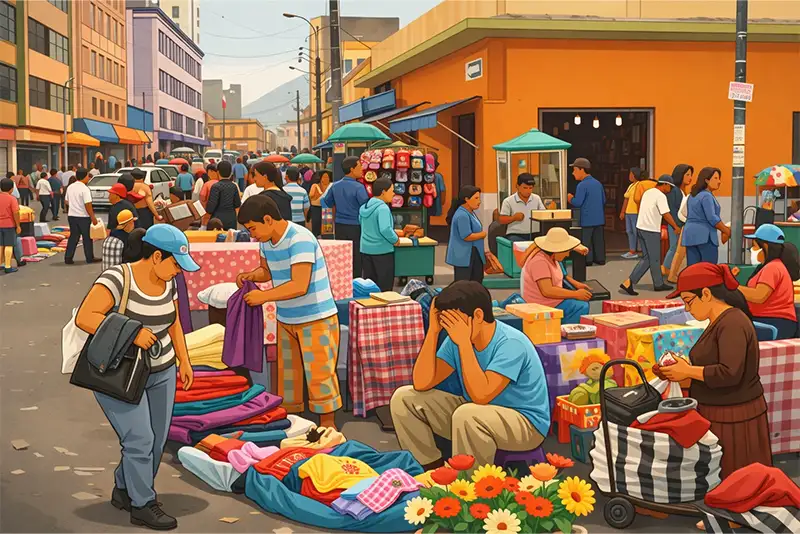
According to the latest figures from the National Institute of Statistics and Informatics (INEI), in Peru, 70.7% of people work in the informal economy. This means that 7 out of 10 workers do not have a permanent contract, don't know if they will be able to continue working tomorrow, and do not have access to social protection, such as health insurance or a pension. These are people who, despite their best efforts, live in constant uncertainty.
But what does this mean for our mental health? The SALURBAL project (Urban Health in Latin America), in which the Cayetano Heredia University of Peru participated, analyzed more than 5,000 workers in 11 Latin American countries and found that working in the informal sector increases the risk of experiencing depressive symptoms by 27%. In other words, job insecurity directly impacts our emotional stability.
This happens because our brain needs to feel secure to function properly. When we work in precarious conditions, without stability, without knowing what tomorrow will bring, our brain enters a state of constant alert. It's like having an alarm that never turns off. This continuous tension can wear us down, affect our mood and sleep, and, in some cases, lead to disorders such as depression.
Pero hay algo aún más importante que destacar. La misma investigación revela que las mujeres que trabajan en empleos informales enfrentan un 36% más de síntomas depresivos en comparación con las mujeres en trabajos formales. ¿Por qué? Porque muchas de nosotras cargamos con una doble jornada: al trabajo afuera, sumamos las tareas del hogar y el cuidado de los hijos. Esa doble carga, que se ha normalizado en nuestra cultura, puede ser muy agotadora para la mente, y si además no contamos con seguridad laboral o una red de apoyo, la tensión se vuelve aún mayor.
Este no solo es un problema individual; es un desafío estructural. Los gobiernos, las empresas y la sociedad debemos pasar a la acción para lograr cambios reales. Aquí algunas ideas clave que podemos impulsar basadas en la evidencia de esta investigación.
Si sientes que la carga del trabajo y la vida te pesa demasiado, no te juzgues: esa sensación es real y tiene una explicación científica. No es que estés exagerando. Apóyate en tu familia, habla con tu comunidad; compartir el peso ayuda a aliviar la tensión. Tu salud mental y tu tranquilidad deben ser siempre tu prioridad.
Based on the article: Association between informal employment and depressive symptoms in 11 cities in Latin America by Tran B Huynh, Vanessa M Oddo Bricia Trejo, Kari Moore, D Alex Quistberg, Jannie J Kim, Francisco Diez-Canseco, Alejandra Vives. https://pmc.ncbi.nlm.nih.gov/articles/PMC9187523/

©2025. Hecho con (❤︎) en Yachayninchik


